of surveyed Indian consumers say they actively work on their health. Source ↗
Product requirements · Grocery discovery
Zealthy.
Make it easier to find groceries that fit your food preferences—and understand why each product matches.
UX prototype · static
Trust, not a health scoreShow the evidence behind each dietary attribute.

say finding healthier options is difficult. Source ↗
want health labels to be easier to understand. Source ↗
do not fully trust health products or services. Source ↗
01 · The opportunity
Make the choice easier.
Make the match explainable.
A focused product-discovery layer inside grocery—not a new store, a diet plan, or a blanket promise that an item is “healthy.”
Preference matching takes too much work
Shoppers who follow food preferences often need to search across products and interpret labels to decide whether an item fits. Public consumer research reports difficulty finding healthier options, label-comprehension challenges and trust concerns. This PRD addresses that job with explicit attributes and evidence on each match.
Quick-commerce grocery shoppers with food preferences
People choosing packaged grocery for themselves or a household, across life stages and shopping contexts—such as students, working adults, caregivers and families. Targeting is by the preference being applied, not by occupation or age.
Core job
Find stocked grocery products that match my selected food preference, and see the evidence so I can choose confidently.
Evidence boundaryThe linked market and consumer research establishes category context. Zepto-specific adoption, repeat use, conversion and revenue impact are measured through the controlled pilot defined below.
02 · Market evidence
Signals support the need.
The pilot measures product impact.
Consumer research, quick-commerce scale and adjacent launches provide market context. Zepto-specific conversion, feature adoption and revenue impact are evaluated with the experiment below.
Consumer signal
Shoppers say health discovery is confusing.
NIQ’s India survey reports difficulty finding healthier alternatives and low confidence in claims made by health products and services.
51%struggle to find healthier alternatives in the market
47%don’t fully trust products/services aimed at improving health
Label-literacy signal
Label comprehension is a real friction point.
A 2026 Pune higher-education student study surveyed 401 people.
51.6%showed poor label comprehension
54.4%found serving sizes difficult to interpret
Platform scale
Large market; no feature-level lift estimate.
Zepto’s FY26 filing reports scale, not DAU or demand for Zealthy.
47.97Mannual transacting users
640.18Morders in FY26
Quick-commerce context · industry estimate
Category scale and metro concentration make a focused pilot plausible; neither number sizes the Zealthy opportunity. Redseer report
50M+monthly transacting users estimated
70–75%of GMV from the top eight metros
Specialist grocery
FirstClub
TechCrunch reported 170,000 households and 1M+ orders in its first year, with about ₹1,200 average order value and 4+ orders per customer per month. Quality-led signal only—not evidence of health-filter demand.
Reported figures ↗Adjacent experience
Swiggy
Introduced a no-added-sugar category in its food experience, a signal that attribute-led discovery is being explored.
Announcement ↗Within Zepto
Zepto Cafe
Already lists a Healthy category for Cafe. The question is whether verified dietary-attribute discovery helps across grocery.
Category ↗The gap to test: Do shoppers need grocery-wide discovery by verified dietary attributes, with clear evidence, inside their existing quick-commerce journey? Avoid claiming this is an untouched market or that Zepto would be first.
03 · Pilot scope
Small surface area.
Strong evidence bar.
Launch a focused grocery discovery flow using three clearly named attributes, location-aware availability and auditable product evidence.
In the v1 pilot
- A Zealthy entry point in grocery discovery
- Three pilot filters: No added sugar, High fibre and Gluten-free; explicit eligibility criteria are a launch gate
- Location-aware, in-stock products only
- Attribute badges plus a “Why this matches” evidence detail
- Products with unknown evidence remain in normal browsing without a badge
No added sugarHigh fibreGluten-free
Not in the first pilot
- Medical, pregnancy, infant-feeding, disease-management or personalized diet advice
- A universal “healthy score” or implying untagged products are unhealthy
- LLM-only eligibility decisions based on incomplete data
- Changes to delivery promises, pricing, or fulfillment
- Quietly relaxing a dietary filter when there are no matches
Scope boundary: The prototype also depicts high protein, vegan and Jain-friendly options; they are not part of v1. Pregnancy, baby-suitability and disease-related filters are excluded from v1 because they require specialized review and governance.
04 · Shopper experience
A short path from intent to confidence.
The four Canva UX screens are bundled with this page. Select any screen to open the zoom viewer.
01EnterGrocery home or search
02ChoosePick dietary filters
03CompareScan matching items
04VerifyInspect “Why this matches”
05BuyAdd to cart as usual
01
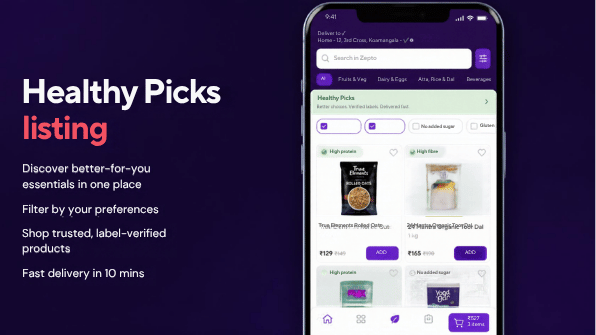
Zealthy listing
Preference chips, product cards and quick access to the section.
02
Filter preferences
Multi-select filters with sensitive categories clearly disabled.
03
“Why this matches”
Show the source basis for the dietary attribute, not a generic health promise.
04
No matches
Explain the state and let shoppers adjust filters without silently changing them.
Prototype status: Static UX frames with illustrative sample products and content. Product names, images, claims, nutrition, availability, location, delivery timing and offers are not production catalog data. Final build must use Zepto design tokens and approved catalog evidence.
05 · Requirements
What the pilot must do.
P0 requirements are necessary to run a safe, measurable test. Feedback collection is useful but not a launch blocker.
Reach the section
Expose Zealthy from the agreed grocery entry point in the pilot.
Filter eligible products
Only approved, verified attributes and selected-location availability appear in results.
Combine and clear filters
Keep selected filters visible; clear-all restores the unfiltered section.
Explain every match
Each displayed badge has a source record and a human-readable explanation.
Handle no stock or no evidence
Explain empty states; never relax or substitute a dietary filter silently.
Measure the funnel
Track section view, filter selection, results, item view, add-to-cart and order completion.
Capture trust feedback
Offer a lightweight feedback action after viewing match evidence or completing an order.
AI + catalog controls
AI can assist. Rules decide.
An AI-extracted attribute is not a shopper-facing claim until its evidence is reviewed and the approved rule says it qualifies.
Package image, ingredient list, nutrition panel, manufacturer spec.
Suggest structured attributes with evidence snippets and confidence.
Reviewer records source, date, status and change history.
Versioned rules—not generative output—decide which SKU qualifies.
Show only supported attributes; keep unknown or conflicting data hidden.
Required safeguards: Missing, stale, low-confidence or conflicting evidence stays out of filters. AI-drafted copy must be grounded in the stored record and must not introduce unsupported health benefits or medical claims.
Catalog requirementsRequired fields for every pilot SKU
Products without complete, current approved evidence stay unbadged and out of attribute-filtered results. Launch only in service areas where pilot SKU evidence and stock coverage pass the audit.
06 · Expected outcomes
Faster discovery.
Incremental orders and revenue.
Success is defined by observed user and business outcomes in a controlled pilot—not by a forecast inferred from market size.
Find a matching item faster
Higher task completion and lower median time-to-match than the current grocery search journey.
More completed grocery orders
Positive treatment-versus-control lift in completed-order conversion for eligible shoppers.
Incremental value per shopper
Positive treatment-control net revenue delta per eligible shopper, with a two-sided 95% confidence interval above zero.
Every badge can be explained
100% of live pilot SKU-attribute pairs audited against current approved evidence before exposure.
| Metric | Success criteria | Expected outcome |
|---|---|---|
| Primary · purchase conversion | Completed-order rate for eligible users assigned to treatment vs. randomized control; intent-to-treat. Success: positive lift with a two-sided 95% confidence interval above zero. | Incremental orders attributable to the discovery experience. |
| Incremental net revenue per eligible shopper | Net order revenue after discounts, refunds and cancellations ÷ all users assigned to each cohort. Success: positive treatment-control difference in ₹ per user with a two-sided 95% confidence interval above zero. Report contribution margin alongside revenue when finance data is available. | Observed incremental revenue contribution from the feature, measured in the experiment—not projected from platform totals. |
| Discovery success and time-to-match | Task completion rate and median time from a shopper’s stated preference to a qualifying product page, compared with the current browse/search flow. | More shoppers find an item, with less search effort. |
| Feature activation and repeat use | Zealthy visits, filters applied, add-to-cart, completed order and 30-day return purchase, segmented by selected preference and self/household shopping context. | Clear view of feature adoption and repeat utility; app DAU/WAU remain secondary context, not promised lift. |
| Evidence comprehension | Share of usability participants who can correctly identify why an item matches and what evidence supports its badge; record a 1–5 confidence rating. | Shoppers understand the attribute rather than relying on a vague health claim. |
| Launch quality gate · attribute correctness | Audit every shopper-visible SKU-attribute pair in the launch assortment before exposure; require an approved, current source for each pair and zero unsupported badges. | Complete evidence traceability before the pilot is exposed to customers. |
| Guardrail · core grocery health | Compare overall grocery conversion, cancellation rate, unavailable-item rate and net revenue per order against control; pre-register a non-inferiority margin before randomization. | Zealthy adds value without materially harming core order outcomes. |
Report actual lift, not a made-up forecast.
Conversion lift = treatment rate − control rateIncremental revenue (₹) = (net revenue per eligible treatment user − net revenue per eligible control user) × eligible treatment users. Include confidence intervals and report contribution margin alongside revenue when finance data is available.
These are decision targets, not predicted results. No Zepto-specific baseline or feature-level impact data is available in this PRD, so it makes no numeric DAU, MAU, order-volume or rupee-revenue forecast. The randomized pilot will estimate those outcomes and their confidence intervals. DAU/WAU are monitored as secondary diagnostics rather than attributed to this feature without causal evidence.
Research the job
Interview 5–8 quick-commerce grocery shoppers spanning self and household shopping, work, study and caregiving contexts.
Verify the catalog
Audit all pilot SKU evidence, eligibility rules and inventory in the selected service area.
Usability test
Compare the prototype with current search; measure task completion, time, evidence comprehension and trust.
Run randomized pilot
Assign eligible users to treatment/control; calculate sample size from observed baseline and a pre-agreed minimum effect.
Evaluate full outcome
Read the experiment after sample size and the full 30-day repeat window mature; apply quality and conversion guardrails.
Rollout rule: Expand only when the primary order-conversion outcome is positive, all shopper-visible tags pass the evidence gate, and core grocery outcomes stay within the pre-registered guardrails.
07 · Risks & launch gates
Clear the evidence gates before exposure.
The pilot can proceed when customer research, product-claim governance, catalog quality and experiment instrumentation meet the entry criteria below.
Catalog gaps or stale data
Audit source fields and verified-tag coverage before selecting the pilot area.
Ambiguous health language
Use named attributes with explicit meanings; never label the full assortment healthy.
Incorrect or misleading badge
Keep evidence provenance, review dates, audit sampling, correction and removal paths.
Medical interpretation
Keep pregnancy, infant and disease-related suitability out of v1; obtain specialist review before any future exploration.
Pilot entry criteria
- Complete shopper discovery with participants across self-shopping and household-shopping contexts; confirm the three scoped attributes meet a repeated need.
- Document an expert-reviewed definition, evidence hierarchy, owner and correction path for No added sugar, High fibre and Gluten-free.
- Audit every shopper-visible SKU-attribute pair in the selected service area; suppress products with missing, stale or conflicting evidence.
- Assign product, catalog and customer-support owners for eligibility rules, evidence review, corrections and escalations.
- Before randomization, register baseline, minimum detectable effect, sample size, primary metric, analysis window and guardrail margins.
08 · Sources
Evidence, with its limits.
Source links are attached to the specific market and platform signals they support. Study population and forecast limits are stated alongside the figures.
01NIQ · India Health & Wellness, 2025India findings from a 19-country online survey of nearly 19,000 adults; the release does not give the India subsample size.
02Pune higher-education student study, 2026401 students; useful young-adult label-literacy signal, but not a representative grocery-shopper or Zepto sample.
03Redseer · Quick-commerce market estimate, 2026Industry estimate/forecast for monthly transacting users and metro GMV concentration; does not size this feature.
04Zepto Limited · UDRHP-IFY26 annual transacting users and orders. Annual transacting users are not DAU or MAU.
05TechCrunch · FirstClub figures, June 2026Reported households, orders, AOV and frequency; not causal evidence for health-filter demand.
06FirstClub · Company siteReference for its current quality-first grocery positioning.
07Swiggy · No-added-sugar category announcementAdjacent food-discovery signal; not the same grocery use case.
08Zepto Cafe · Healthy categoryCurrent adjacent category example; availability may depend on delivery location.
Market scale, competitor activity and survey responses provide context; none of these sources measures Zealthy adoption or causal revenue, conversion, DAU or retention impact. Those outcomes are measured in the randomized pilot.